Understanding Eligibility and Documentation
By Roseanne Berry

At the core of every hospice’s mission is a simple but profound commitment: to care for all eligible patients who want hospice services. Fulfilling that mission requires a clear, consistent, and defensible understanding of hospice eligibility and the documentation that supports it.
Hospice eligibility is about prognosis, not diagnosis. It is determined by the certifying physician through a concise narrative that explains the clinical findings supporting a life expectancy of six months or less. That narrative is not a formality. It is the foundation on which eligibility, compliance, and payment all rest.
CMS and its Medicare Administrative Contractors have broad authority to conduct both prepayment and post-payment medical reviews. Their purpose is to ensure that Medicare pays only for services that are reasonable and necessary. From a financial and operational standpoint, hospices cannot afford to provide uncompensated care, whether through nonpayment following a prepayment review or recoupment after post-payment review.

The most common and most concerning denial reason remains familiar to all hospices:
“The claim has been fully or partially denied because the documentation submitted for review did not support a prognosis of six months or less.”
Eligibility challenges exist on both ends of the spectrum. On one end is the risk of admitting patients without sufficient documentation to support prognosis. On the other is the difficult and often uncomfortable decision to discharge a patient when it appears they are no longer eligible. When a patient is discharged and then dies shortly thereafter, the emotional and ethical impact on staff, patients, and families can be profound.
To support prognostic decision-making, hospices are provided Local Coverage Determinations developed by the Medicare Administrative Contractors. LCDs outline medical criteria commonly associated with terminal illness. While they serve as important guidance and are frequently used by Medicare reviewers in payment determinations, they are not the legal standard for hospice eligibility. A patient who does not meet LCD criteria may still be eligible for the Medicare Hospice Benefit, provided there is clear and thoughtful documentation explaining why. That explanation is best articulated by the hospice physician.
This is where the physician narrative becomes critical. Strong physician narratives are built on strong interdisciplinary communication and documentation. They reflect a comprehensive understanding of the patient’s clinical course, not isolated data points.
Effective physician narratives draw from multiple sources, including the clinical record, IDG discussions and presentations, face-to-face findings, and relevant outside records such as labs or consult notes. Weakness in any one of these areas can undermine the strength of the narrative and increase risk during medical review.
Strong physician narratives are built on strong interdisciplinary communication and documentation.
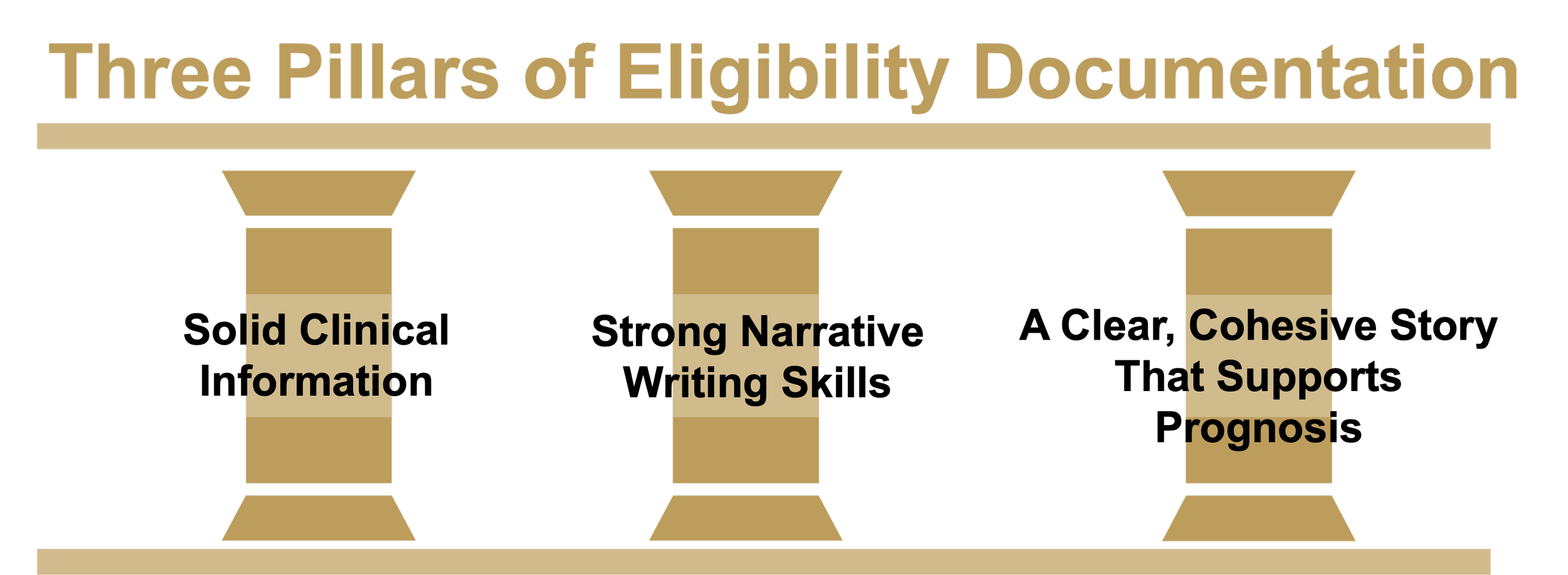
At its best, eligibility documentation rests on three pillars: solid clinical information, strong narrative writing skills, and a clear, cohesive story that supports prognosis.
To understand how well your organization is performing in this area and where potential risks may lie, there are several key questions every hospice should routinely ask.
First, how do you identify your risk areas? Are you an outlier in length of stay, use or duration of higher levels of care, location of care, diagnostic mix, or live discharges? Understanding your data in context is essential to anticipating scrutiny.
Second, what processes are in place to evaluate how well documentation supports eligibility before claims are submitted? A robust prebilling audit process should be a core component of every hospice compliance program. That process should provide leadership with insight into risk, allow for remediation when possible prior to billing, and offer meaningful feedback to the IDG.
It is important to assess not only what your prebilling audit process is intended to be, but what it actually is. What percentage of records are reviewed? Are higher-risk cases prioritized? How are findings communicated, and how are they used to drive improvement? Just as importantly, how are audit findings incorporated into onboarding and ongoing education for clinical staff?
Third, how effective is the feedback provided to the IDG? Does it meaningfully improve their understanding of eligibility and documentation expectations over time? And how do you measure that improvement?
Finally, when a patient is discharged due to loss of eligibility, is the decision grounded in thorough assessment and comparison over time? Is there a structured follow-up with the patient and family to evaluate whether the decision was appropriate? These moments carry significant clinical, ethical, and emotional weight and deserve careful reflection.
Answering these questions allows hospices to focus their limited resources where they matter most. Medical review is no longer a question of if, but when. Routinely evaluating eligibility processes and documentation, rather than treating them as one-time initiatives, strengthens a hospice’s ability to withstand review while staying true to its mission of caring for those at the end of life.